The military is really amazing at a lot of things, but perhaps nothing outshines their ability to prepare. They meet to brainstorm for meetings about assembling material for a meeting that is one hundred percent about preparation for some event, project, training, or deployment. Thoroughly and overly prepared is a gross understatement, and the levels to which they went were sometimes dizzying. Our men and women in uniform spend their entire careers getting ready, running through every possible scenario or outcome, acting some of them out, practicing for days or weeks on end for situations they may never see, and then they wait.
There was perhaps no better example of this than the work-up for deployment. Months of preparation for drills and live fire exercises, so much gear issued that basically came home with tags on it, dusty but still brand new, some of which still takes up space in foot lockers in my laundry room, and mounds and mounds of paperwork. This period of equipping for the worst duty of all, the attendance of war, eventually touches the homefront beyond the frayed nerves and the sheer loneliness of knowing your loved one is here and safe, but is not here as he or she gets ready to leave, preparing to travel a world away into a place that is inherently unsafe. In the midst of the readying we have a meeting, a gathering time in which someone explains the ins and outs of Power of Attorney documents, how to mail a care package, and most importantly The Protocol. It was in December 2005 that I heard the run down of how I would learn if or when something happened to my husband in the theater known as combat. A phone call, a call and visit, and worst of all was a visit without warning. No less than two people in dress uniform, one will be a chaplain, the car will be plain, they will come at any time, no one else will know before you do.
I had been prepared twelve years earlier, almost exactly to the day, seeing as they left after Christmas that year, and in my gut I knew what was happening when I saw them. Two people, a detective in a suit and the victim ‘s assistance advocate I had met with on more than one occasion, in a plain government vehicle, unannounced, walking up my sidewalk as I stood in the sun on the front porch. I remember being on the porch because a Santa on a motorcycle had driven by, I stepped outside to catch another glimpse, a ray of light before the dark would set in, it would at least provide a moment of warning as I watched them somberly walking towards me, an opportunity to collect my wits as I began to understand before the words even came.
There weren’t a lot of details, apparently, it was clear he had done something to hurt himself, here is a number to call, they are expecting to hear from you, and it is not good. We are so sorry, if there is something we can do, please take your time. It took a minute for me to react to the shock and the disappointment of it all, to begin sucking in the words instead of speaking them aloud, and then the hot angry tears came. It may have taken me minutes or hours, I have no way of knowing for sure, to pick up that phone while I prepared for all the scenarios I might hear. ICU, no vitals, revived, seizures, loss of oxygen, these were the words used during that phone call. I would fill in his history. I would develop a blinding headache as I cried wondering how I would tell anyone and I would feel sick as I began to make calls no one wants to make. The calls I prepared for a dozen years prior.
He was already four days into his stay at the ICU that day, the day I was approached by everyone with a strange combination of delicacy and bluntness. There would be approximately three and a half more weeks from that day until the final breath; one week of secret phone calls so the kids would have a Merry Christmas without incident for the first time in years; days of preparing how to talk to them, who would be there, when it would be time for them to see him “one last time;” many days of heartache, break, and sickness, always followed by anger; hallway meetings and phone calls with doctors, a small room filled with tissues and grief resources, one conference table with his team, and decisions that I wish I did not have to make.
The brain is plastic, as we are learning more and more, it is so amazing and capable of tremendous healing, but there is a razors edge when it comes to how long is too long for it to survive without oxygen. After six minutes the brain begins to die and increments of seconds begin to matter after that, a subtle and yet significant difference when it comes to predicting recovery and functionality. No one knew how long he had gone without and considering his history of brain trauma there was no way to know if he had any chance of meaningful recovery. They kept Jeromye heavily sedated to keep his seizure activity at bay, a telltale sign of the hypoxic brain injury he had suffered, slowly walking it back as the inflammation eased, until we could be sure that the flat lines on the EEG indicating all but brain stem function had ceased were accurate.
My trauma was officially gift wrapped and topped with a bow. Christmas was solemn, punctuated with moments of joy thanks to our dear friends and family. But I knew and the kids did not, and I held those cards desperately close, waiting for the right moment to change their world. The weight was crushing, they will never be the same after this and how you handle their responses, the way you answer their questions, will determine the path they will walk from here on. I held the keys to all the doors, like a cosmic janitor, the weight drawing me down causing a limp to one side, as I prepared to mop up the tears and collect up whatever pieces scattered onto the floors.
None of the men in camo that night had prepared me for this, but luckily, the pool of resources had become as vast and deep as the ocean over the course of those twelve years. I had been blessed to be born into a loving and supportive family, I had the good fortune of collecting up the fiercest and most amazing tribe of people that would ever rally around anyone, and I had the practice of yoga; breathe, acknowledge, honor, release, repeat, repeat, repeat.
And that is exactly what we did, over and over again. Sometimes it looked like falling to our knees, oftentimes it included scooping up our pieces, and mostly it was tightening up our hold on one another and retreating into our own safe space without apology. And all at once, in that space, we began to fall apart and rebuild from the years of hurting.

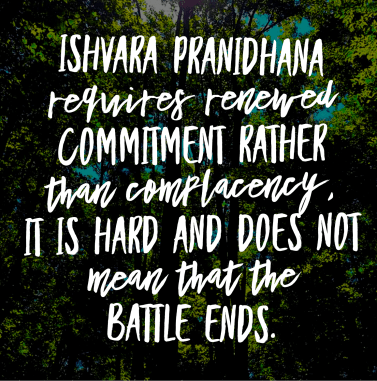 The thing about surrender is we immediately see the image of the white flag on the battle field. It connotes giving up, losing, folding your hand and walking away or even being captured. The kind of surrender I am talking about is active, not passive, it requires renewed commitment rather than complacency, it is hard and it does not mean that the battle ends. In the philosophy of Yoga this is known as Ishvara Pranidhana and as I dove head first into my own studies, preparing to become a teacher, it was this aspect that would have my small town Methodist roots converging with the ancient work of Patanjali and my modern experience on and off the mat. It was this type of surrender that saved me from the madness.
 soft enough to flow” would become an important affirmation for me. It would remind me that through faith in God, the Divine, Universe, Soul, whatever I wanted to call it in the moment, I could simultaneously summon the strength to deepen my roots, standing my ground when necessary, and yet allow the winds of change to blow freely through my life. It would remind that God had brought me this far already and that certainly He would see me through it all.
 Finding Om in the OMG